BestBidets guide
Bidet Tank Clearance Guide
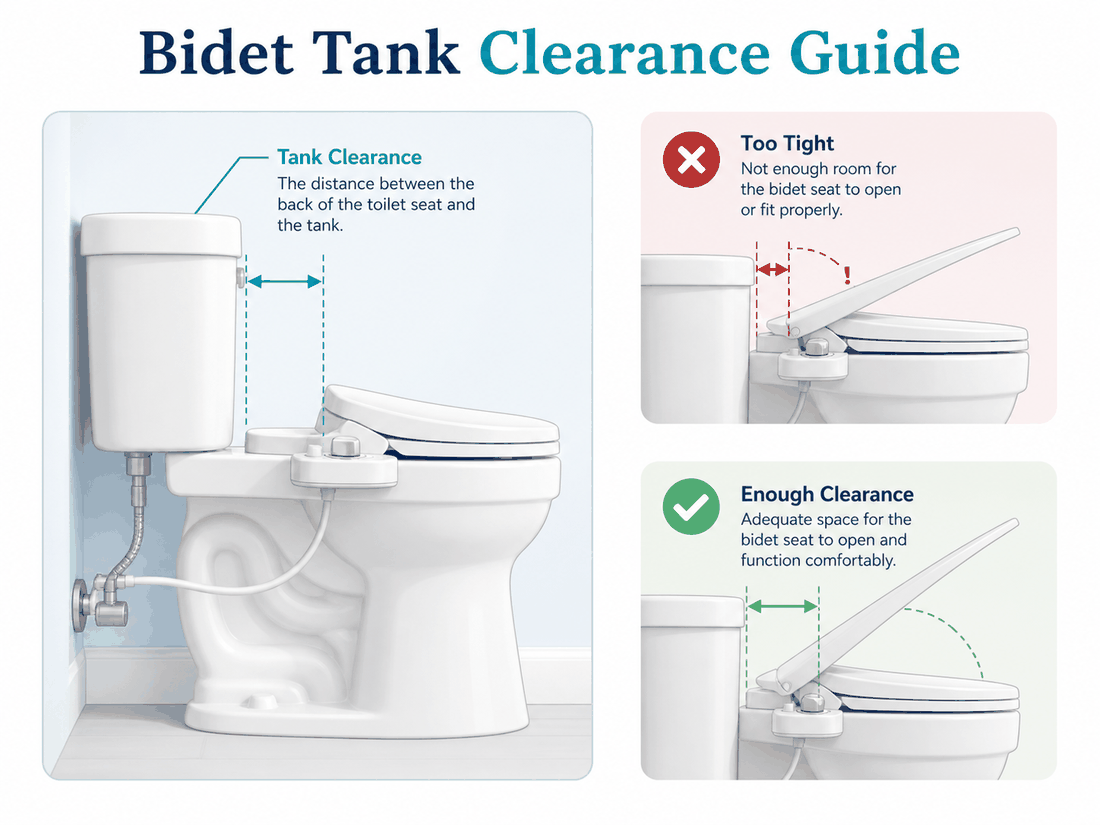
Tank clearance is the boring measurement that can ruin a good bidet purchase. It matters most for electric seats because the rear housing needs space between the bowl and tank.
BestBidets may earn a commission from qualifying purchases. Product details can change; confirm current specs, fit, and safety information with the manufacturer or retailer before buying.
The short version
Before buying a bidet seat, measure the space from the seat bolt area to the tank and compare it with the exact manufacturer fit guide. Elongated bowl shape alone does not guarantee fit.
Best options by situation
| Situation | Best direction | Why |
|---|---|---|
| Standard two-piece toilet | Usually easier | Still check rear housing clearance |
| One-piece toilet | More caution | Curved tanks can crowd the bidet body |
| Compact toilet | Higher return risk | Shorter bowls and tight tanks can conflict |
| Attachment | Less affected | Still check seat stability and nozzle alignment |
What to check before buying
- Check tank shape, not just bowl shape.
- Look for a manufacturer fit guide or spec diagram.
- Confirm the lid can open and the seat can slide onto its mounting plate.
- Treat one-piece and skirted toilets as higher-check situations.
Practical buying advice
Tank clearance is one reason product reviews can be misleading. A seat that fits someone else’s elongated toilet may still be wrong for your elongated toilet if the tank geometry is different.
BestBidets rule of thumb
Start with the bathroom, not the product name. Fit, outlet access, water connections, and who will use the bidet should decide the category before you compare models.
Avoid these problems
- Buying before checking toilet fit, outlet access, and water connections.
- Choosing a feature because it sounds premium when the bathroom does not support it.
- Ignoring cleaning, leak checks, cord routing, or user confusion.
- Assuming a rental, condo, or guest bathroom can be treated like a primary owner-used bathroom.
Final verdict
Before buying a bidet seat, measure the space from the seat bolt area to the tank and compare it with the exact manufacturer fit guide. Elongated bowl shape alone does not guarantee fit. The right choice is the one that works cleanly in the room without creating outlet, leak, fit, or usability problems.
- Most forgiving setup: a standard two-piece elongated toilet with clear space behind the bolt holes.
- Higher-risk setup: compact one-piece toilets and tanks that curve forward.
- Real-world issue: the seat may mount, but comfort and lid alignment can still feel off.
Owner-style takeaway
Measure the flat space between the bolt holes and the tank before ordering. A seat that barely fits on paper may still feel cramped in daily use.
The frustrating part is that a toilet can look “standard” in a photo and still be annoying in person. The back of the seat may press against the tank, the mounting plate may not slide far enough forward, or the bidet may fit technically but leave the user sitting too far forward.
Tank clearance is one of those details that feels overly technical until the seat is half-installed and will not sit right. Owner complaints often come from toilets with curved tanks, unusually short bowls, one-piece designs, skirted bases, or hinges that leave less usable space than expected.
The clearance issue buyers underestimate
This is where small bathroom details matter. Fit, clearance, water pressure, outlet access, and ease of cleaning often decide whether the bidet feels like a smart upgrade or an awkward add-on.